You know how to code. You have probably built an app, maybe a website, maybe something you are genuinely proud of — and honestly? That already puts you ahead of most people. That is not a small thing.
But here is the thing.
If you can do all of that without DSA — what exactly is DSA giving you that you do not already have? Let's understand this together, with a small story.
The balloon room
Picture a big hall. Hundreds of people inside, laughing, talking, minding their own business. And floating above all of them — balloons. One for every person in the room, each one with a name written on it in black marker.
Then the host picks up a mic and says: "Alright everyone — find your balloon."
And just like that, the room explodes. People are reaching up, grabbing whatever is closest, squinting at names, tossing balloons across the room, bumping into each other. Someone's balloon pops. Someone else is holding four that are not theirs. It is loud, it is messy — and slowly, painfully, after a lot of chaos — everyone eventually finds their balloon.
It worked. But at what cost?
Now imagine one person in that same room who thinks about it differently. Instead of rushing, they pick up the nearest balloon, check the name, and simply walk it over to the person it belongs to — who is standing just a few steps away. That person does the same for someone nearby. It spreads, quietly, like a small calm wave across the room.
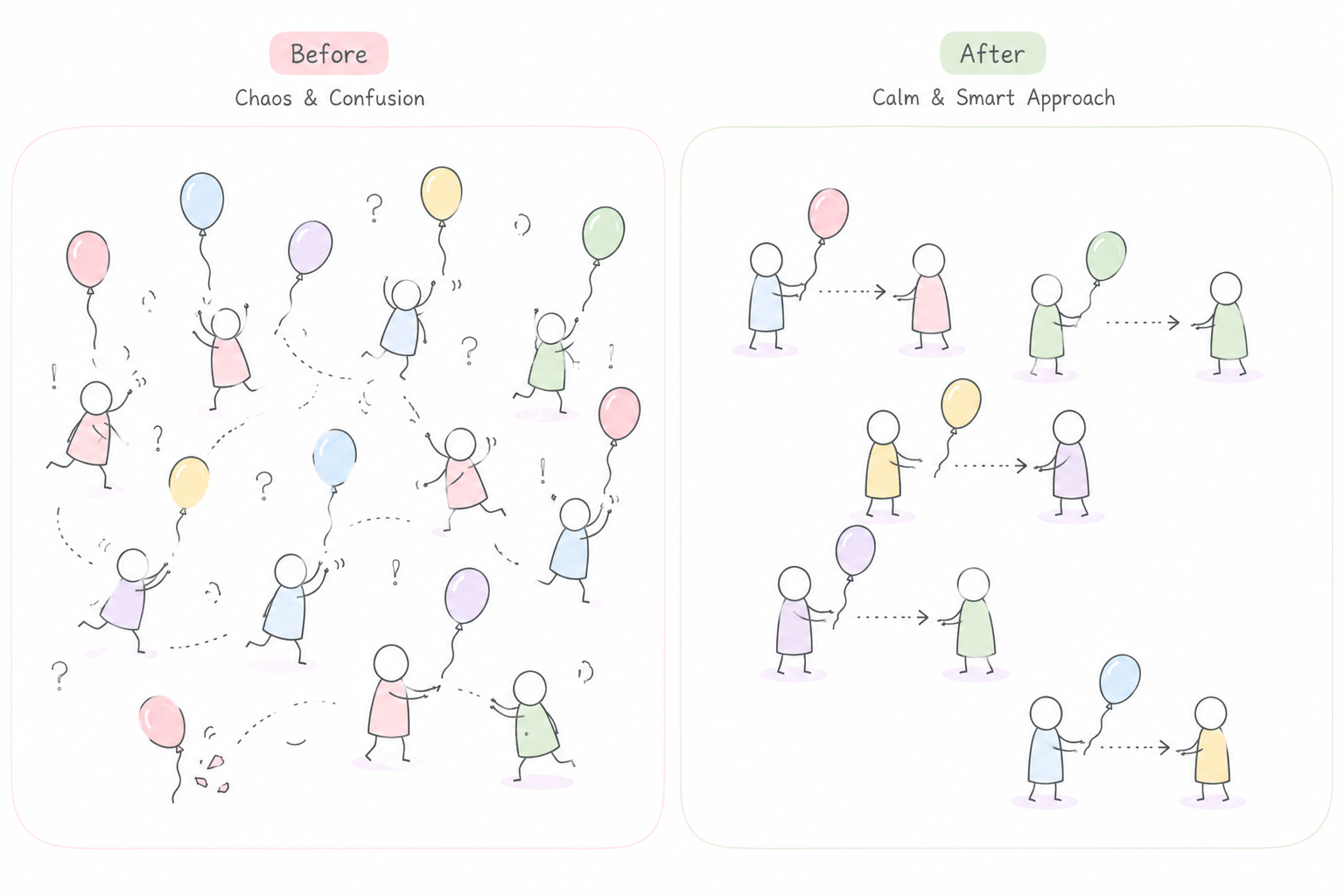 <
p class="articleP">Within minutes — it is done.
<
p class="articleP">Within minutes — it is done.
Same room. Same balloons. Same people. Just a different way of thinking about the problem — and the outcome was completely different.
What it actually builds in you
You start thinking differently
You recognize problems you have seen before
Most hard problems are not new — they are old problems in new clothes. DSA teaches you the patterns underneath, so instead of starting from scratch every time, you already know the shape of the solution.
You develop an instinct for new problems
When something truly unfamiliar shows up, you have the instinct to say — wait, I have seen something like this. Maybe I can adapt that idea here. That instinct is not luck. It is built slowly, through practice.
Your logic gets sharper overall
Big problems stop feeling overwhelming because you have learned to peel them apart — to find the smaller problem hiding inside. That skill bleeds into everything you build, not just algorithmic challenges.
The career part
And yes — interviews too
Every serious company tests this
Google, Microsoft, Amazon — almost every company that takes engineering seriously has a DSA round. Not to test your memory, but to see how you think when the problem is hard and unfamiliar.
It opens doors that stay closed otherwise
Learning DSA does two things at once — it makes you genuinely better at building things, and it gets you into rooms you could not get into before. That is a rare combination.
Is it even worth learning DSA in the era of AI?
Yes. AI can think, and AI can solve problems too. No denying that.
But here is the real question: when AI gives you a solution, can you tell if it is actually good? Or bad? Can you spot when it is inefficient, or wrong, or just not the best way to do it?
That is the skill that matters now. Not whether AI can solve it, but whether you can judge what it solved.
And that judgment does not come from nowhere. It comes from your own problem-solving skill, the same skill DSA builds in your brain, practice after practice.
There is another side to this too. With AI by your side, you can now think of and take on much bigger problems than before, things that would have felt out of reach on your own. But tackling something bigger still needs the same thing underneath: strong problem-solving skill. That is what lets you break a large, messy problem into pieces you can actually work with, AI or no AI. And that skill is exactly what DSA builds.
That is who we are becoming. Let's get started.